
By Mica C. Tufillaro | Founder, LIS Analytics
Two separate legal and regulatory filings hit the wire this week that, taken together, expose the exact vise closing around gigawatt-scale digital infrastructure:
1. The Technical Wall (Physics): PJM Interconnection formally ejected Oklo’s 750 MW hybrid energy project (150 MW advanced nuclear + 300 MW fuel cells + 300 MW gas) from its Cycle 01 queue review. Why? Because the developer failed to provide a compliant, working dynamic simulation model that mathematically proves how this multi-technology facility behaves during transient grid faults. PJM’s position at FERC is uncompromising: no validated electromagnetic stability model, no queue position. Estimated delay: 14 to 24 months.
2. The Financial Wall (Ratepayer Economics): Microsoft appealed to the Virginia Supreme Court to overturn State Corporation Commission (SCC) rules that require hyperscale data center developers to pay upfront for the massive high-voltage transmission upgrades their facilities trigger. Despite high-profile White House “ratepayer protection pledges” and corporate PR commitments to shield families from rising power bills, the tech giant is fighting in court against paying direct, upfront costs for Dominion Energy’s $1.5B+ transmission expansions.
The Pattern Is Unmistakable
For the last five years, digital infrastructure development operated under a double cushion:
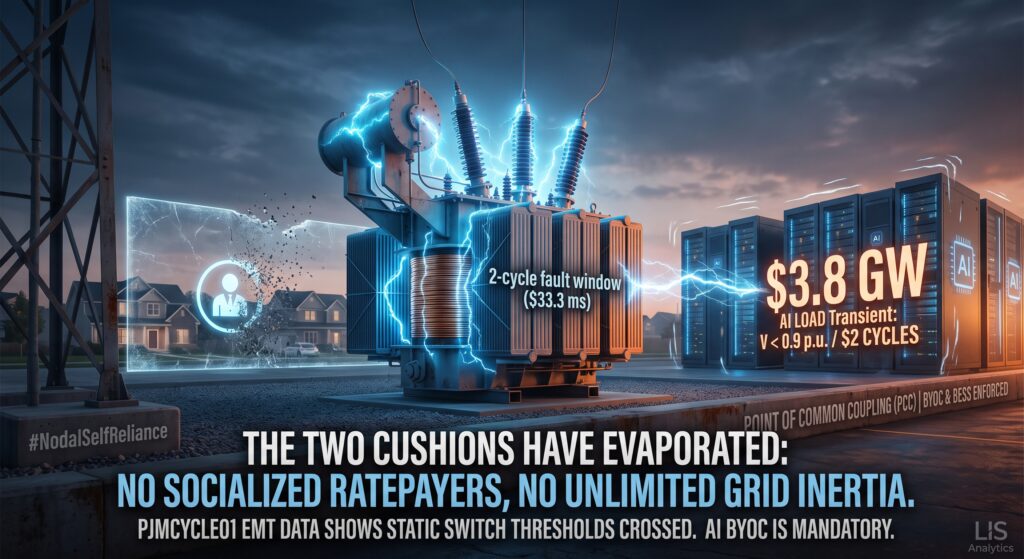
- The Technical Cushion: Treating the bulk electric transmission system as an infinite, unbreakable shock absorber that could passively soak up fast-switching GPU step-loads and accept complex behind-the-meter generation without rigorous dynamic modeling.
- The Financial Cushion: Assuming that multi-billion-dollar bulk transmission upgrades (345 kV and 500 kV lines, substations, and static VAR systems) would simply be folded into broad utility rate bases and socialized across millions of captive residential utility bills.
Both cushions just deflated simultaneously.
1. Interconnection Is Not an Administrative Form – It Is an Electromagnetic Physics Exam
Wall Street, venture capital, and tech executives celebrate Nuclear Regulatory Commission (NRC) pre-application meetings, Department of Energy (DOE) safety reviews, and corporate Power Purchase Agreements (PPAs).
None of those milestones mean a single electron reaches a cluster of server racks.
Before an advanced nuclear reactor, fuel cell, or combustion turbine can synchronize to the wire, it must survive the Regional Transmission Organization’s (RTO) rigorous dynamic stability screening.
In a post-3.8 GW transient tripping world, PJM dispatchers and transmission planning engineers will not accept black-box generator models. If an applicant cannot mathematically prove how its inverters, synchronous governors, and excitation systems react to a standard 2-cycle (33.3 ms) voltage sag (V < 0.9 p.u.), the facility does not get energized.
The queue does not award bonus points for clean tech labels. If your electromagnetic transient (EMT) modeling is deficient, you lose your queue priority. Period.
2. “Cost Causation” Has Arrived at the Statehouse
While tech firms sign non-binding federal pledges promising to “protect residential ratepayers,” state utility commissions and state legislatures are grappling with local reality:
residential electricity bills are climbing double digits, and communities are revolting.
Virginia’s SCC drew a firm, legally grounded boundary: If your data center buildout triggers a $1.5 billion transmission expansion, you must pay for that iron upfront.
You cannot:
- Demand dedicated high-voltage capacity on accelerated timelines,
- Privatize the computational upside and shareholder valuation, and then
- Socialize the stranded asset risk and 40-year capital cost across residential utility meters.
Challenging that upfront cost allocation in state supreme courts may buy legal time, but it deepens public backlash and accelerates state-level legislative crackdowns nationwide.
The Operational Takeaway: The Mandatory Pivot to Nodal Self-Reliance
The era of relying on paper grid assumptions and subsidized public corridors is over.
If developers want to energize gigawatt-scale loads before 2030, the only viable operational path forward is Nodal Self-Reliance:
✔ Sub-Cycle Dynamic Integrity: Engineering verified dynamic voltage ride-through at the Point of Common Coupling (PCC) using grid-forming BESS and synchronous condensers – holding terminal busbar voltage (V > 0.9 p.u.) during routine transmission faults so sensitive static switches don’t trigger cascading trips.
✔ Bring-Your-Own-Capacity (BYOC): Placing firm, dispatchable behind-the-meter generation directly at the site boundary to avoid triggering billion-dollar macro grid upgrades.
✔ Self-Balancing Grid Citizenship: Operating as an autonomous, islandable node capable of buffering internal dynamic step-loads locally rather than relying on public spinning reserves.
The macro power grid is neither an infinite shock absorber nor an infinite bank account. Are your generation and site development roadmaps engineered for verified ground-truth physics and busbar economics – or are you caught between an interconnection queue ejection and a ratepayer revolt?
Leave a Reply