
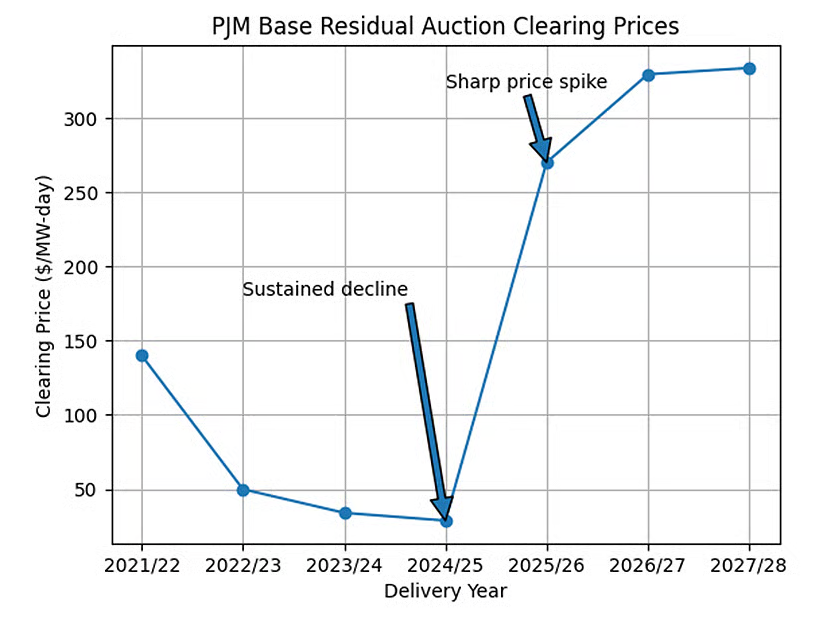
When wholesale capacity prices explode from under $30/MW-day to over $330/MW-day, the market isn’t sending a gentle price signal. It is screaming a physical warning.
Today, FERC conditionally approved PJM’s Reliability Backstop Procurement mechanism – then immediately suspended its implementation for five months to investigate if elements like cost allocation are “just and reasonable.”
Concurrently, FERC flagged the absurdity of PJM’s legacy tariff: a construct so passive it requires three consecutive failed capacity auctions below the target reserve margin before PJM can even petition FERC to administer an emergency procurement.
This is the textbook definition of the Execution Gap between regulatory jurisprudence and electrical engineering.
1. Procedural Time vs. Physical Lead Time To a regulatory commission, five months is standard administrative process.
To the high-voltage grid, five months of procedural delay is a structural hit:
• You cannot commission an extra kilowatt of firm generation in a hearing room.
• You cannot compress the 36-month manufacturing queue for a 500 kV transformer with a legal brief.
• A 2-GW hyperscale compute step-load won’t pause construction while attorneys litigate Section 205 filings.
2. A Legacy Construct Built for Surplus FERC was right to question PJM’s legacy rules. Waiting for three failed auctions made sense in an era of surplus coal and flat load growth. Today – facing rapid thermal retirements and non-linear data center demand – waiting for three straight capacity failures is the operational equivalent of waiting for a house to burn down before dialing 911.
3. Market Signals Don’t Generate Megawatts The capacity price trajectory is the ground truth: PJM has shifted from sustained low clearing prices to a steep plateau north of $300/MW-day. High prices were supposed to spur investment. But capital cannot deploy if the queue is backlogged and heavy iron supply chains are constrained.
The Reality FERC can pause a tariff. Attorneys can file briefs.
The physics of the grid does not pause. Load surges, thermal units retire, and hardware lead times stretch.
Until market designs treat decision latency as an active reliability hazard, we will continue pricing capacity at record highs while running the grid on paper margins.
Leave a Reply