
By Mica C. Tufillaro | Founder & Principal, LIS Analytics™
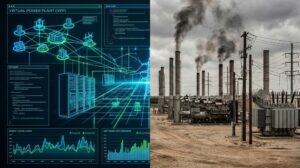
Two headlines crossed the wires this week that illustrate the dangerous divergence between how the technology sector models grid solutions on paper and how physics operates at the substation fence.
In Silicon Valley, Google and Voltus announced a partnership to assemble a 1-gigawatt “virtual power plant” (VPP) across several U.S. markets. The initiative promises to unlock flexible computational loads, orchestrate distributed energy resources, and mitigate capacity crunches using algorithmic dispatch.
On the same day in Texas, environmental and grid reports revealed that nearly 300 planned data center projects across ERCOT risk reversing decades of state air quality gains. Because bulk transmission queues and firm capacity additions take years to build, facilities are increasingly relying on massive behind-the-meter diesel backup fleets—effectively functioning as unpermitted, high-emission peaker plants in regional airsheds.
One story sells a narrative of friction-free software agility. The other exposes the physical consequence of unhedged iron.
When capital markets and corporate sustainability teams confuse code with concrete, the resulting execution gap doesn’t stay on a slide deck—it gets pushed directly onto local communities, public health, and the bulk electric system.
1. The Virtual Power Plant Mirage: Negawatts Are Not Inertia
The concept of a 1-GW Virtual Power Plant sounds compelling in an ESG prospectus. By aggregating distributed batteries, commercial building HVAC setpoints, and flexible data center compute jobs, software promises to throttle load down when the grid is strained, creating “virtual capacity.”
In regulatory and market design, this is the modern descendant of FERC Order 745 and demand-response accounting: treating avoided consumption as the operational equivalent of physical megawatts injected at the busbar.
From a control-room and power-engineering standpoint, however, negawatts and physical iron are fundamentally different assets:
- No Mechanical Inertia: A software algorithm shedding server loads does not supply physical rotational inertia or frequency response to arrest Rate of Change of Frequency (RoCoF).
- Step-Load Volatility: When a data center curtails 50 to 100 MW in seconds to participate in an automated demand-response signal, it introduces severe sub-cycle transients, voltage sags, and harmonic distortion across the local distribution bus. As NERC highlighted in its recent Level 3 Essential Actions Alert, abrupt multi-hundred-megawatt load drops from computational facilities are triggering unpredicted system oscillations in both the Eastern and Texas Interconnections.
- Non-Firm Dispatchability: Code depends on network communications, telemetry availability, and tenant contractual willingness to curtail. When grid conditions turn catastrophic during a winter freeze or prolonged summer heat dome, computational workloads can only be throttled so far before operational and service-level agreements (SLAs) bind.
You can aggregate 1 GW of curtailment rights inside a cloud platform. You cannot use software code to stabilize an under-damped transmission corridor.
2. The Peaker Creep: When the Map Collides with the Terrain
While corporate marketing teams celebrate virtual power plants, the operational reality on the ground in Texas tells a starkly different story.
Hyperscalers and colocation developers are deploying gigawatts of compute far faster than ERCOT or local transmission operators can construct 345 kV and 500 kV interconnections. Facing multi-year interconnection queues and thinning reserve margins, developers are taking the path of least physical resistance: installing vast arrays of multi-megawatt diesel generators behind the customer meter.
Originally permitted strictly as emergency life-safety equipment—governed under relaxed runtime caps—these backup fleets are experiencing what we term “Peaker Creep.”
- From Backup to Baseload Support: When locational marginal pricing (LMP) spikes to market caps, or when local transmission nodes face thermal saturation, the operational temptation to crank behind-the-meter diesel engines to bypass grid constraints becomes irresistible.
- The Emissions Shell Game: A utility-scale combined-cycle natural gas plant must undergo years of rigorous Clean Air Act Title V permitting, continuous emissions monitoring (CEMS), and selective catalytic reduction (SCR) scrubbing. A 500-MW distributed fleet of reciprocating diesel engines, permitted incrementally as “emergency standby” assets across multiple adjacent parcels, bypasses these structural environmental controls.
- Air Quality Degradation: The cumulative particulate matter (PM₂.₅) and nitrogen oxide (NOₓ) emissions from nearly 300 projects across Texas do not disperse into a statistical vacuum. They concentrate in regional air basins, eroding decades of regulatory progress while shifting the true environmental cost of 24/7 compute onto local residents.
3. Double-Counting Resilience: The Core Failure Mode
Why do these two contradictory realities exist simultaneously? Because the AI infrastructure ecosystem is built on double-counting resilience:
- The Software Side: Hyperscalers point to their virtual power plant commitments and carbon-neutral PPAs to satisfy ESG raters and enterprise clients.
- The Hardware Side: Site developers install massive, fossil-fueled reciprocating engines at the fence line to ensure the facility never actually drops a packet when the grid falters.
- The Utility Side: Grid operators model the data center as a high-load customer that can theoretically be curtailed under extreme conditions, while simultaneously relying on the same constrained transmission paths to wheel remote wind and solar into load centers.
Everyone assumes the other party holds the physical risk. The developer assumes the utility will eventually build the line; the utility assumes the customer will curtail when asked; and Wall Street assumes synthetic software contracts eliminate the need for hard capital expenditures on physical grid infrastructure.
The Forensic Reality
The physical terrain does not care about financial or software abstractions.
A 1-gigawatt virtual aggregation is an operational optimization tool, not a physical substitute for firm transmission capacity, synchronous condensers, and sub-cycle harmonic containment. When local planning commissions and utility boards accept software promises in place of verified physical infrastructure, the result is predictable: delayed interconnection queues, over-stressed transmission assets, and diesel exhaust billowing across rural townships.
Until regulators and planning boards mandate forensic physical verification—requiring developers to prove sub-cycle power quality compliance (IEEE 519), verified acoustic containment, and non-polluting onsite firm capability before a zoning permit is granted—the gap between code and concrete will continue to widen.
At the busbar, the terrain always wins.
Leave a Reply